
Token Theft - The Cyber Threat That Can Bypass Passwords and MFA
17 Jun 2026
Most businesses understand the importance of strong passwords and Multi-Factor Authentication (MFA). For years, these controls have formed the foundation of cybersecurity protection. However, cyber criminals are increasingly shifting their tactics. Rather than trying to guess or steal passwords, many attackers now focus on stealing something far more valuable which is authentication tokens.
Token theft has become one of the fastest-growing attack methods used by cyber criminals, ransomware groups and nation-state attackers. It is effective because it allows attackers to impersonate legitimate users without needing to know their password or trigger traditional security alerts.
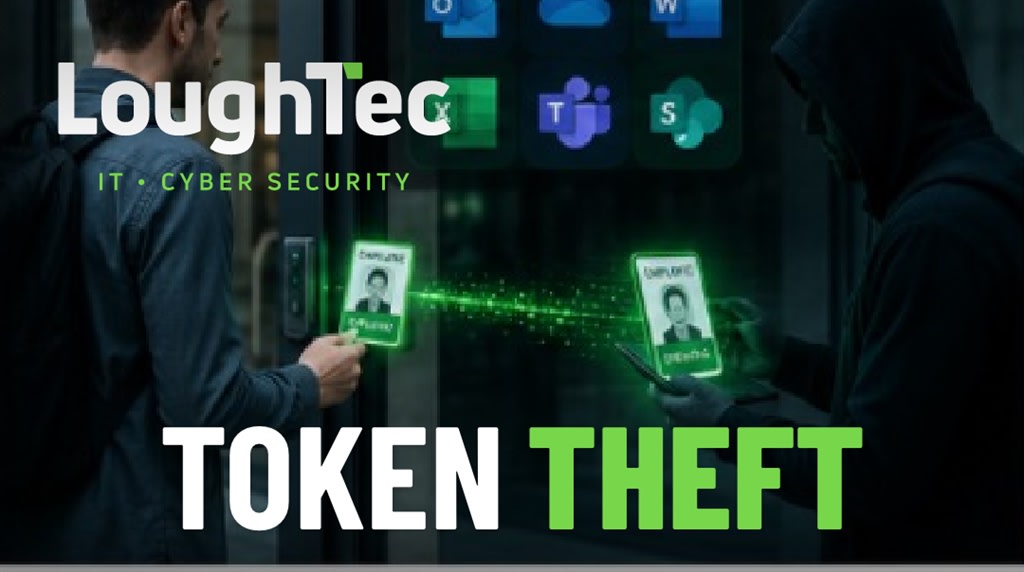
In simple terms, token theft is often the equivalent of stealing a valid access pass rather than trying to forge one.
What Is a Security Token?
Whenever you successfully log into an application such as Microsoft 365, Salesforce, Google Workspace, Dropbox or many other cloud services, the system issues a digital authentication token.
This token acts as proof that you have already verified your identity.
Think of it like checking into a hotel. You show your identification once at reception, and in return you receive a room key. You do not need to repeatedly show your passport every time you enter your room because the key proves you have already been authenticated.
Authentication tokens work in a similar way. Once you have successfully logged in and completed any MFA challenge, the token allows you to continue accessing services without repeatedly entering your credentials.
This improves user experience but also creates an opportunity for attackers.
What Is Token Theft?
Token theft occurs when cyber criminals steal valid authentication tokens from a user's device, browser or application session.
Instead of attempting to steal usernames, passwords or MFA codes, attackers simply steal the token that proves authentication has already occurred.
Once obtained, attackers can often use the token to gain access to business systems as though they were the legitimate user.
This means an attacker may successfully access:
- Microsoft 365
- Outlook email
- SharePoint
- OneDrive
- Teams
- Cloud applications
- Business systems
- Customer databases
without ever knowing the user's password.
Why Token Theft Is So Dangerous
Traditional cybersecurity controls are often designed around protecting passwords.
If a password is compromised, organisations typically expect:
- Failed login attempts
- Suspicious sign-in activity
- MFA challenges
- Account lockouts
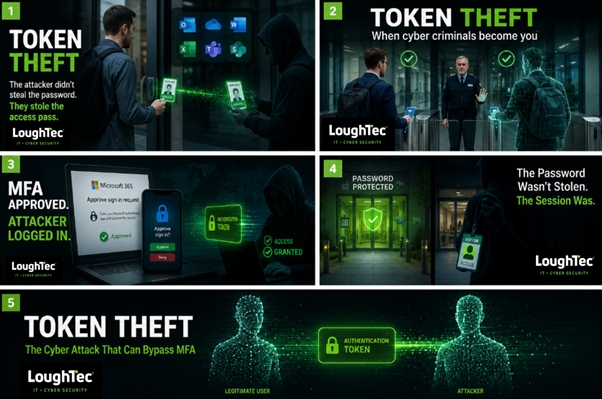
Token theft can bypass many of these controls because the attacker is presenting what appears to be a valid authenticated session.
To security systems, the attacker may look identical to the genuine employee.
This can make token theft significantly more difficult to detect than traditional account compromise.
How Do Cyber Criminals Steal Tokens?
There are several common methods used by attackers, see below list for more information.
Session Hijacking
Attackers may infect a device with malware designed to extract browser session information.
Modern web browsers often store authentication tokens to maintain user sessions. If malware gains access to these stored tokens, they can be stolen and reused.
Adversary-in-the-Middle Attacks
One increasingly common technique involves fake login pages.
A user receives what appears to be a legitimate Microsoft 365 login link. The user enters their credentials and successfully completes MFA.
Behind the scenes, the attacker captures the authentication token generated during the session.
The victim sees a normal login experience while the attacker walks away with a valid authenticated session.
Browser Theft Malware
Certain malware families are specifically designed to target browser data.
These tools search for:
- Cookies
- Saved passwords
- Browser credentials
- Session tokens
- Cryptocurrency wallets
and exfiltrate the information back to criminal operators.
Device Compromise
If an attacker gains access to a laptop or workstation, they may be able to extract tokens directly from memory or application storage locations.
Why MFA Alone Is No Longer Enough
Many organisations mistakenly believe MFA makes them immune to account compromise.
MFA remains one of the most important cybersecurity controls available and should always be enabled. However, MFA protects the authentication process itself.
If an attacker steals the resulting authentication token after MFA has already been completed, they may not need to perform MFA themselves.
This is why cybersecurity professionals increasingly say:
"Attackers are targeting sessions, not passwords."
The goal is no longer simply credential theft. The goal is session theft.
Signs Your Organisation May Be Experiencing Token Theft
Because attackers appear as legitimate users, detection can be challenging.
Potential warning signs include:
- Unusual mailbox activity
- Unexpected email forwarding rules
- Access from unfamiliar locations
- Suspicious file downloads
- New devices appearing in cloud environments
- Data being accessed outside normal business hours
- Unexpected application consent requests
- Abnormal Microsoft 365 activity
Many organisations only discover token theft after a broader compromise has occurred.
Real-World Impact
Token theft can lead to:
- Business Email Compromise (BEC)
- Financial fraud
- Data theft
- Ransomware deployment
- Intellectual property theft
- Regulatory breaches
- GDPR incidents
- Customer data exposure
In many cases, attackers spend days or weeks inside an environment gathering information before launching their primary attack.
How LoughTec Helps Protect Against Token Theft
Preventing token theft requires multiple layers of security rather than reliance on a single control and LoughTec have a trademarked ARP approach and methodology for Assess, Remediate and Protect.
Assess
Understanding your exposure is the first step.
LoughTec can assess your Microsoft 365 environment, identity controls, Conditional Access policies, authentication methods and overall security posture to identify weaknesses that attackers could exploit.
Remediate
Once risks are identified, improvements may include:
- Strong Conditional Access policies
- Phishing-resistant MFA
- Device compliance enforcement
- Session controls
- Browser hardening
- Endpoint protection improvements
- User awareness training
Reducing attack opportunities significantly decreases the likelihood of successful token theft.
Protect
Continuous monitoring is essential.
LoughTec's 24/7 Security Operations Centre (SOC) monitors for suspicious user behaviour, unusual authentication activity and indicators of account compromise.
Combined with advanced endpoint protection, email security and threat detection, organisations gain visibility into attacks that traditional security tools may miss.
Token Theft Is Becoming the New Password Theft
Cyber criminals continue to evolve.
As organisations deploy stronger passwords and MFA, attackers are adapting by targeting authenticated sessions instead.
The reality is that a strong password is no longer enough on its own. Businesses need layered protection, continuous monitoring and proactive threat detection to defend against modern identity-based attacks.
Token theft demonstrates an important truth about cybersecurity: protecting access is no longer just about securing passwords. It is about securing identities, devices, sessions and the entire authentication process.
As attackers become more sophisticated, businesses must do the same.
Frequently Asked Questions
Can token theft bypass MFA?
Yes. If an attacker successfully steals a valid authentication token after MFA has been completed, they may gain access without needing to perform MFA themselves.
Is token theft common?
Yes. Token theft has become increasingly common in attacks targeting Microsoft 365, cloud services and enterprise applications.
Can antivirus stop token theft?
Traditional antivirus may detect some threats, but modern attacks often require advanced endpoint detection, threat monitoring and behavioural analysis.
Can token theft affect Microsoft 365?
Yes. Microsoft 365 environments are a common target because of the sensitive business data they contain.
How can I reduce the risk of token theft?
Strong MFA, Conditional Access policies, endpoint protection, security awareness training, device management and 24/7 monitoring all play important roles.
How can LoughTec help?
LoughTec's Assess. Remediate. Protect. (ARP) framework combines security assessments, remediation services and 24/7 SOC monitoring to help organisations reduce the risk of token theft and other modern cyber threats.
Enquire for a free cyber-attack assessment now.
Back Top